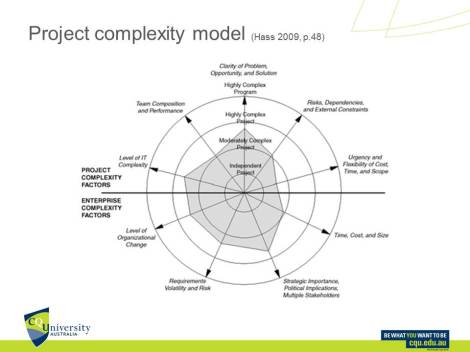
Contingency theory has a rich history and has developed into an important theoretical perspective when seeking to understand organisations at the firm level and the project level. “The essence of the contingency theory paradigm is that organizational effectiveness results from fitting characteristics of the organization to contingencies that reflect the situation of the organisation” (Donaldson, 2001). For example, a parent firm is frequently a dominant part of the project’s environment, and as a result different projects will face different parent-firm-imposed constraints, yielding different project characteristics (Howell, Windahl et al., 2010). The wide acceptance of contingency theory and availability of analytical contingency models for projects suggest that the management of projects can continue to benefit from a contingency approach (Bredillet, 2010). However, Hanisch and Wald (2012) concluded that the application of contingency theory still represents a fragmented field within the project management community with no uniform use of terminology. They suggest researchers focus on establishing a systematic foundation.
 Strategic Project Management for Product Innovation